How can we radically imagine the features & futures of a green and just world?
Radical Imagining of ‘Just & Green’ Futures
In July 2022, Laura Burgers and Ivana Isailovic organized an event that provided a space to reflect on what just futures after the ‘green transition’ would look like by bringing together scholars, thinkers, and artists. Speakers were asked to reflect on what ‘just green futures’ meant to them, and what are the practices, knowledges, and laws that they think should be nurtured and adopted to make just green futures possible. TWAIL Review has now published these short essays based on the presentations, accompanied by drawings from artist Kyra Sacks.
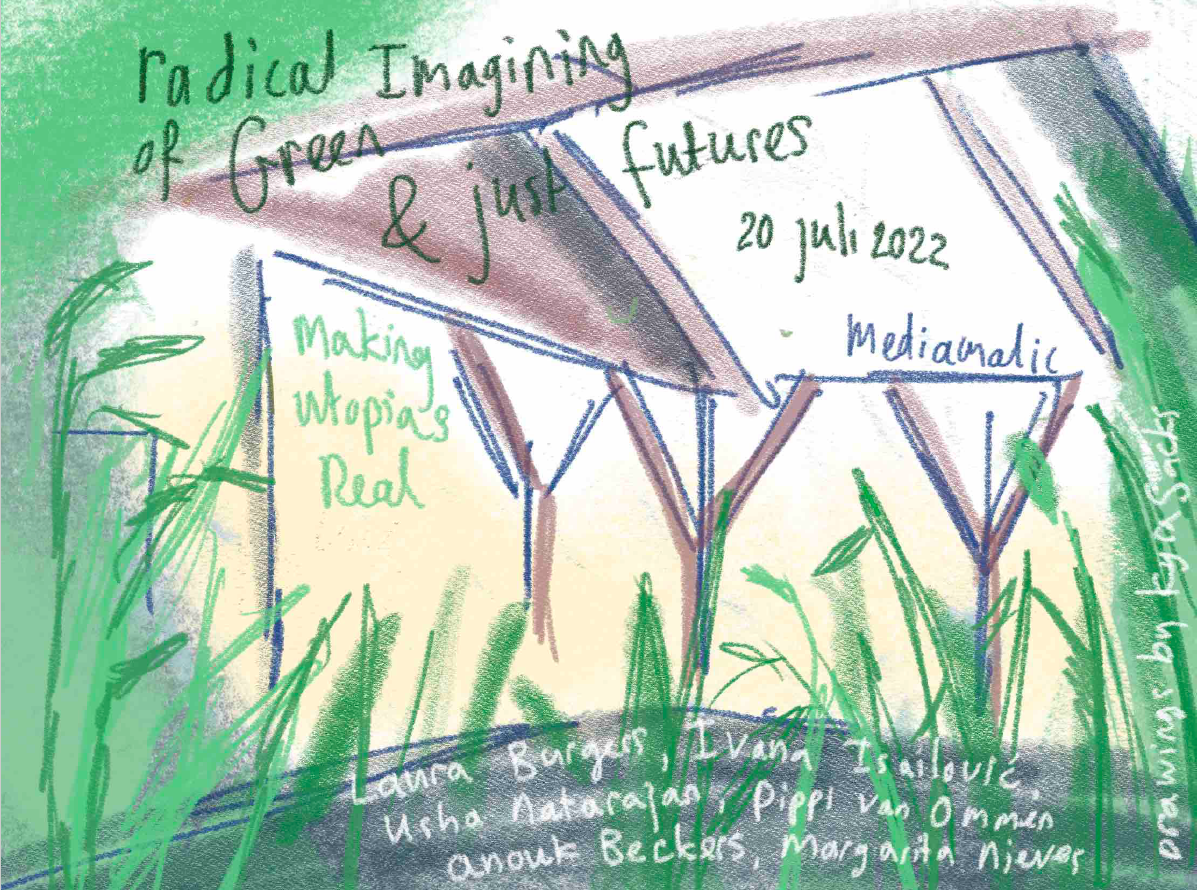
The event was part of the Sustainable Global Economic Law summer school, which every year since 2021 brings together scholars from across the world to reflect on issues at the intersection of global economic law and ecological and social justice. It is part of a broader project on law and sustainable globalization financed by the Dutch Ministry of Education and Science and gathering four law schools: University of Amsterdam, Tilburg University, Maastricht University, and Open University.
Essays on TWAIL Review
Usha Natarajan, one of the leading voices of the Third World Approaches to International Law (TWAIL) movement working on international environmental law. She drew attention to the dominant pattern of knowledge production and European thought based on control over nature.
Margarita Nieves, a Columbian lawyer working on environmental governance and energy transition, talked about her experience of being raised in a region that economically depended on resource extraction.
Pippi van Ommen, an environmental activist that used to be part of Extinction Rebellion, spoke about the difficulty in finding hope in a world where the political elites have ‘sacrificed people to profit’.
Ivana Isailović, Assistant Professor of EU law and academic coordinator of the Sustainable Global Economic Law (SGEL), argued that veganism, which is deeply entangled with feminist ideals, is a small daily act of resistance to the violence that structures our food systems.